Table Mountain
Cape Town
Cape Town is said to be one of the world's most beautiful seaports, with various attractions and vistas on offer, its hard not to fall in love with this city. The most glorious surprise that awaits visitors and locals alike is the majestic Table Mountain.
To find out why Table Mountain is so special to Capetonians, it is worth getting a closer look. The Cape’s icon stands with her base firmly within the Table Mountain National Park, 1 086 metres above Table Bay, undoubtedly the most memorable and striking sight in Cape Town. The national monument and her infamous shape have been used as many a logo and landmark for Cape Town.
Table Mountain so named for its flat top, rose from the ocean some 250 million years ago. The mountain is bordered by Devil’s Peak to the east, and Lion’s Head and Signal Hill to the west. The narrow table is 3km long and 1,086m high, the summit is flat, and the dense white mist that often covers it is called the "tablecloth." Once on top viewers are presented with an awe-inspiring panorama stretching from the city, Table Bay to False Bay around the mountain to Hout Bay and Kommetjie. Best views from the ground would be from Table Bay, from where you can get some idea of the relative size of the mountain, creating a classic picture postcard.
Table Mountain is the most popular tourist destination in Cape Town, with over 16 million people visiting her summit since its opening in 1929. Some illustrious visitors include King George VI, Queen Elizabeth II, and Oprah Winfrey.
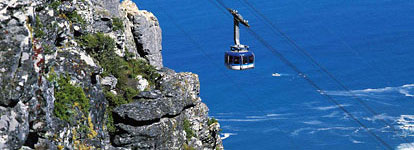
The cable way is the most unique in the world, and weather permitting, transports one the top of Table Mountain. Built in 1929, the cable car operates daily and can take a capacity of 65 people. The floor slowly rotates to give passengers a 360-degree view over Cape Town and Table Mountain as they ascend and descend. Once on top you can go for an easy walk, have a relaxed lunch, and lie in the sun while you look over the world below.
At the top of Table Mountain, visitors can feel free to explore or alternatively a guide can show you around the top of the mountain along the most popular routes and explain the sights. There is a self-service restaurant, which seats 120 people. The restaurant offers a wide range of foods; from breakfast, hot meals, various snacks, coffees and a fine by a selection of local wines.
The Table Mountain National Park area is rich bio-diversity and indigenous flora, and incredibly this exists within one metropolitan area. The area is covered with a wide variety of wild flowers and is the natural home of the Silver Tree; most importantly the Mountain is covered in "fynbos", various types of plant species found in small parts of the Cape area and nowhere else on earth.
If you would like to explore the mountain further then there are 550 walks on Table Mountain, from easy, flat walks to difficult rock climbs. Any person of reasonable fitness can experience the pleasures of Table Mountain on foot, and this has become a huge attraction for adventurous people with facilities available for all kinds of activities.
The Table Mountain National Park area stretches from Signal Hill in the north to Cape Point in the south and includes the seas and coastline of the peninsula, the mountain is undoubtedly Cape Town's most well known and well loved landmark and brings many inspiration to its visitors. As with anywhere in Cape Town, the weather can change quickly, so before planning a trip up this glorious mountain, it’s important to seek local advice from the visitors centre to the bottom of the mountain. On a clear day a cable car goes to the top of the mountain presenting some spectacular views. If it’s raining or very over cast the cable car does not go so make sure to check the weather forecast.
There are Table Mountain and city tours which can be combined and either booked in conjunction with your accommodation, or through the hotel direct. If you would rather decide on tours to do when you are in the country and at the hotel, then book them through the hotel.
|


